Put AI agents into production. Every write, gated and audited.
Archet deploys agents across support, operations, and marketing, with every state-changing action gated and audited. Our first packaged solution is live on Shopify: a shopper Support agent and merchant Operations agent that answer from live store data and execute approved refunds, cancellations, and fulfillment.
Not on Shopify? Bring your own systems through MCP and deploy governed agents across support, marketing, and operations. Start free or explore the enterprise GTM lane.
Live in production · Listed on the Shopify App Store · Approved for Protected Customer Data (Level 2)
See it running in production
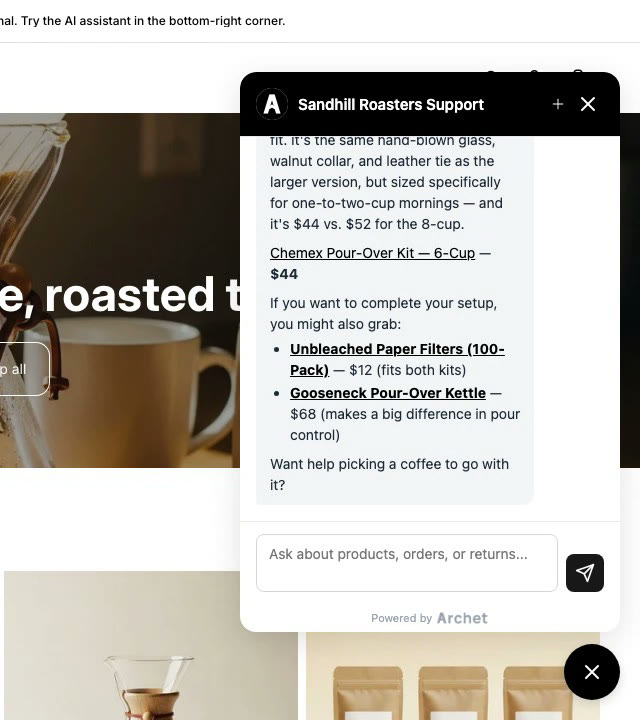
Real interactions from a live Shopify store
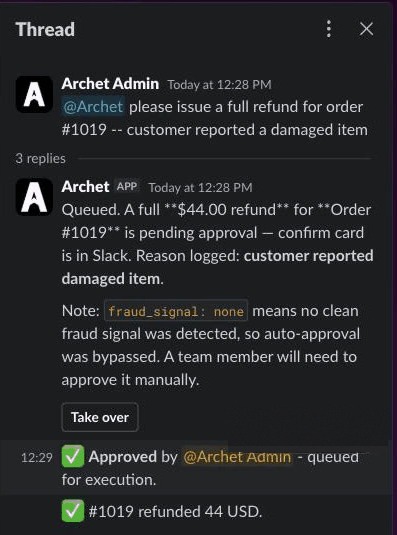
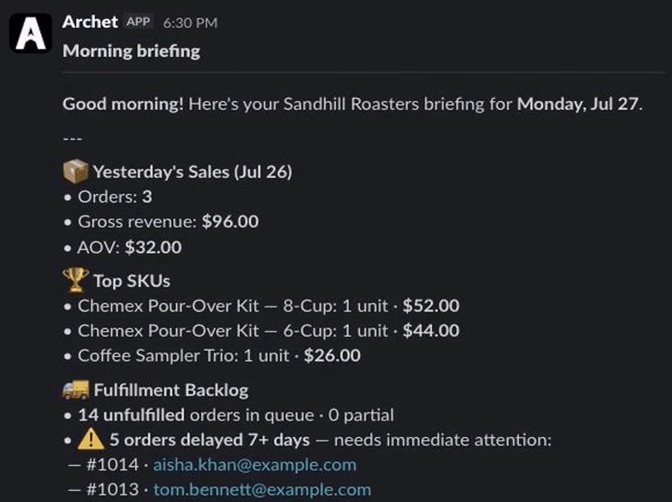
From Sandhill Roasters, our published Shopify demo store. A shopper gets answers from the live catalog; a refund runs through the governed approval gate. Orders are fictional.
66 seconds, all real: a refund and a cancellation approved in Slack, the live storefront agent, and the morning briefing.
How It Works
From zero to deployed agent in three steps
No engineering team required. No workflow diagrams. Just tell your agent what to do.
- 1
Teach it your business
Paste your website URL -- Archet crawls your help center, docs, and product pages. Upload PDFs and docs for anything else. Archet stores complete pages -- not chunks -- and your agent answers from ranked excerpts it cites.
- 2
Configure behavior
Define goals, tone, and guardrails in plain English. Connect tools like Shopify, Slack, or HubSpot so your agent can take real actions — not just talk.
- 3
Deploy everywhere
Embed on your website, respond in Slack, or message on WhatsApp. Your agent goes live across every channel — handling conversations 24/7.
Build vs. buy
The governed runtime your AI team would otherwise rebuild
The runtime, connectors, approval gates, audit trail, and evals are the undifferentiated 80% your AI hire should not rebuild from scratch. Archet ships them, governed, so your team ships outcomes instead of infrastructure.
Rebuild it in-house
- The agentic loop, tool boundary, and streaming and replay
- Per-connector MCP integrations with KMS-encrypted credentials
- Risk-tiered approval gates on every state-changing write
- A complete audit trail with full state history
- Multi-tenant isolation at the data layer -- SQL-level org boundaries
- An eval and QA harness, multi-channel delivery, and usage metering
Then keep all of it secure, tested, and on-call.
Archet's governed runtime
- ✓The governed agent runtime, shipped and live in production today
- ✓MCP connectors with credential isolation, ready to attach
- ✓Approval gates and audit built into every write -- not bolted on
- ✓Multi-tenant org isolation enforced in code, at the data layer
- ✓Eval and QA, human handoff, and web, Slack, and WhatsApp out of the box
- ✓Predictable billing with a fair-use ceiling -- measured by work completed, not tokens
vs. building in-house
Ship agents this week, not a platform this year. Your team configures behavior in plain English and owns the outcomes -- not the runtime, the connector plumbing, or the on-call.
vs. Clay
Clay is the workbench for enrichment and lists. Archet is the governed operator that takes the action and logs it. They compose -- Archet doesn't replace your data tooling.
vs. Agentforce & Sierra
Org boundaries and approvals are enforced in code, at the SQL and JOIN level -- not prompt-only guardrails. Measured by the work agents complete, not tokens burned.
Security & governance
Controls that make agent autonomy safe to ship
Governance is not a policy document here -- it is enforced in code. These are the controls behind every action an Archet agent takes.
Our Shopify integration is approved for Protected Customer Data (Level 2).
Request the security overviewEnvelope-encrypted credentials
Connector secrets are encrypted with Cloud KMS envelope encryption, never stored in plaintext.
Isolation at the data layer
Multi-tenant boundaries are enforced with SQL-level org scoping in the query itself, not just in application code.
Complete audit trail
Every action is recorded with full state history -- request, approval, execution, and outcome -- filterable by actor, resource, and time.
In-code approval gates
State-changing writes are risk-tiered and gated in code -- not prompt-only guardrails a model could talk its way around.
Enterprise SAML/SSO
SAML single sign-on is deployed and activated per customer at onboarding, with domain-verified identity binding.
No training on your data
We do not train models on your data. Widget sessions are pinned to domain allowlists to prevent unauthorized embedding.
Platform
Everything you need to ship AI agents
Five pillars on one governed runtime -- configure, deploy, and audit from a single dashboard.
Governed Action
Agents draft every state-changing action, a risk-tiered gate holds it for approval, then Archet executes it and records the outcome. Consequential actions default to one-click approval; you can opt into capped, policy-bound auto-approval per action type.
Context & Connector Hub
Attach MCP connectors -- Shopify, Salesforce, Slack, and more -- with credential isolation, and set goals, tools, and guardrails in a plain-English Builder. Agents act on approved context, not guesswork.
Grounded knowledge & evaluation
Crawl help centers and upload docs; agents answer from bounded, ranked excerpts of the sources you attach and cite them. Every conversation is automatically scored for accuracy, tone, and resolution.
Multi-channel delivery
One agent configuration, three channels: a website widget (one script tag), Slack (also your merchant operations surface), and WhatsApp Business -- with branding and domain controls.
Audit & analytics
Every action is logged with full state history -- request, approval, execution, outcome -- filterable by actor, resource, and time. Track conversation trends and usage alongside it.
Integrations
Connects to your entire stack
MCP connectors let your agent take real actions. On Shopify, that includes governed refunds, cancellations, and fulfillment from Slack, with authorized approval and a durable audit trail.
Built on the Model Context Protocol (MCP). Custom connectors available on Business and Enterprise plans.
Where Archet runs today
One governed runtime, two lanes
The same approve-execute-audit runtime, at two stages of maturity. Commerce is live in production; enterprise GTM is in early-access pilots.
Commerce
Live in productionA published, Shopify-reviewed agent pair. A Support agent answers shoppers across three isolated Shopify surfaces; an Operations agent drafts refunds, cancellations, and fulfillment from Slack that default to one-click approval, with narrow, merchant-controlled auto-approval. Signed-in order lookup uses Customer Account OAuth with per-session KMS tokens, and provisioning self-heals on every install.
Enterprise GTM
Early-access pilotsA read-only RevOps agent answers pipeline questions in Slack over a seeded Salesforce org today -- buyer-touchable, no writes. The governed write path, warehouse reads, and nine installable GTM agent templates are built on the same gate. The foundation is shipped; we are forming a small group of early-access design partners.
Klaviyo, Salesforce, and Marketo governed writes follow the same approve-execute-audit model as Shopify order actions -- on a different execution path. Featuring Shopify validates the rest: it is the live proof the runtime ships.
Marketing ops
Marketing Stack Health for Shopify + Klaviyo
Run a read-only audit across Shopify and Klaviyo. Archet checks cart, checkout, and order signals; reconciles Klaviyo-attributed revenue against Shopify orders; flags likely pixel and configuration conflicts; and detects deteriorating flows. You get an evidence-backed report with the next action.
The audit itself does not send or change data. Klaviyo uses a read-only private API key; Shopify uses Archet's standard app permissions, disclosed before connection.
Controlled-production evidence
0--4 sec
One run persisted 14 finding rows
On August 31, 2026, one Archet-controlled production run recorded 6 healthy, 3 warnings, 0 critical, and 5 unknown findings.
Use Cases
Built for teams that need AI that works
E-commerce Support
Handle order inquiries, returns, product recommendations, and shipping questions. Connects to Shopify to pull real order data.
SaaS Helpdesk
Resolve technical questions using relevant excerpts from the knowledge sources you select. Escalate complex issues to your team with the conversation context attached.
Lead Qualification
Engage website visitors, answer product questions, qualify leads, and push qualified prospects to your CRM automatically.
FAQ
Common questions
What makes Archet a “governed” agent runtime?
Every state-changing action an agent takes is drafted, gated behind an in-code, risk-tiered approval, executed, and written to a complete audit trail with full state history. The approval gates and multi-tenant org boundaries are enforced in code -- at the SQL and data layer -- not through prompt instructions a model could ignore. Consequential actions like refunds default to one-click human approval.
What can the agent actually do beyond answering questions?
Through MCP connectors, agents take real actions. On Shopify, the Operations agent can draft refunds, cancellations, and fulfillment from Slack for an authorized owner or member to approve before Archet durably executes them and records the outcome. Connector writes to systems like Salesforce and Klaviyo follow the same governance model: draft, approve, execute, audit.
How do approvals and auto-approval work?
Consequential order actions default to one-click approval by an authorized owner or member. You can opt into auto-approval per action type under a policy you control. Refund auto-approval additionally requires a positive cap, a matching currency, and no fraud signal -- otherwise the action falls back to human approval. Every request and outcome is recorded.
Which AI models does Archet run?
Archet is a model-flexible runtime. Agents run on Claude by default, and OpenAI models are available to organizations approved for them. Model choice is a per-agent setting on eligible plans, and the governance, approval, and audit layer is identical regardless of the underlying model.
How is my data secured and isolated across tenants?
Credentials are envelope-encrypted with Cloud KMS. Multi-tenant isolation is enforced at the data layer with SQL-level org boundaries, and widget sessions use domain allowlists to prevent unauthorized embedding. Every action is recorded in a complete audit log with full state history. Enterprise SAML/SSO is deployed and activated per customer at onboarding, and we do not train models on your data. Our Shopify integration is approved for Protected Customer Data (Level 2).
Can a human take over a conversation?
Yes. Archet includes built-in human-in-the-loop workflows. Agents escalate automatically when they hit their limits, and your team can take over any live conversation with full context. Approval workflows gate sensitive actions behind human review, and you can hand the conversation back to the agent when the issue is resolved.
How does Archet use my documentation?
Archet stores complete crawled pages and uploaded documents, then uses full-text search to select the most relevant sources and passes bounded excerpts to the agent. Answers stay grounded in the sources you attach to that agent, and responses cite them.
Where can I deploy my agent, and do I need to write code?
Deploy to three channels today -- a website chat widget (one script tag), Slack (@mention the agent, and the merchant operations surface), and WhatsApp Business. All channels share one agent configuration. You configure the agent through a visual Builder in plain English, so the only code is the one embed script.
How much does it cost?
Archet has a free tier with 50 conversations per month to evaluate, and paid plans start at $49/month. Billing is predictable: above your plan's fair-use ceiling, excess is charged at 2× the underlying model cost within your period cap, and your widget keeps answering instead of being shut off. See pricing details.
Put Shopify agents into production, governed from day one.
Install the live Support and Operations agent pair, or book a 30-minute walkthrough of the governed-action loop.